
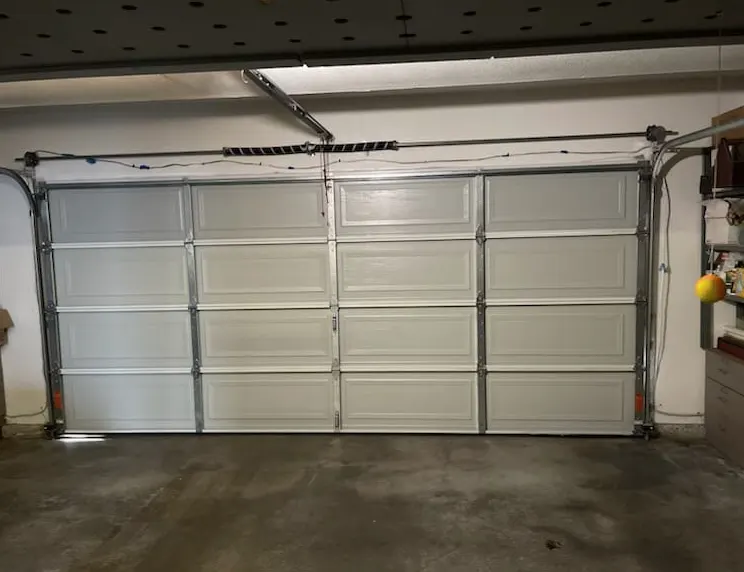
What a Technician Sees on a Typical Call Like This
It usually goes the same way: a family closes on a house, moves in, and within a few weeks they call us because the door is grinding, sagging on one side, or won't close all the way. When we ask if the inspection report mentioned the garage door, the answer is almost always "it just said the door opens and closes." That's technically true and almost useless. A general home inspector tests whether the door moves. They rarely check whether it's balanced, whether the springs are near the end of their life, or whether the hardware was ever upgraded to handle the wind loads that come with hurricane season here. Those gaps get expensive fast, especially with the humidity and storm exposure common around Micanopy, Gainesville, and the rest of Alachua County.
If you're under contract on a house, or you just moved in and want to know what you're working with, walk the garage with this list before you call anyone.
The Checklist
1. Manual balance test
Disconnect the opener (pull the red release cord) and lift the door by hand to waist height, then let go. A properly balanced door stays put. If it drops, it means the springs are worn out or undersized for the door's weight. If it shoots upward, the springs are over-tensioned. Either way, you're looking at a spring replacement sooner than later, not a minor adjustment.
2. Spring condition and gap width
Look at the torsion spring above the door. Rust along the coils, especially pitting instead of just surface rust, means moisture has been getting at it for a while. Stretched-out gaps between coils on one side versus the other mean it's already lost tension unevenly. Springs are rated for a certain number of cycles, and a previous owner's maintenance habits (or lack of them) are invisible on a basic inspection.
3. Cable fraying at the drum
The cables that run alongside the springs should be smooth and tightly wound around the bottom drums. Frizzy strands, kinks, or visible rust are a sign the cable could snap under load. A snapped cable lets one side of the door drop suddenly, which is a safety issue, not just a repair.
4. Track alignment and base rust
Sight down the vertical tracks from the floor. Gaps between the rollers and the track, or a track that's visibly bent near the bottom, point to past off-track incidents that were pushed back into place rather than properly repaired. Rust at the base of the tracks is common here because of ground moisture and humidity, and it accelerates wear on the rollers.
5. Bottom panel condition
Run your hand along the bottom panel and check for swelling, soft spots, or flaking paint. Wood and composite doors absorb moisture in this climate, and a panel that's swollen from repeated humidity exposure won't seal properly against the afternoon downpours typical of the wet season, which leads to water intrusion and eventually rot.
6. Weatherstripping and bottom seal
Check the rubber seal along the bottom and sides. Cracked, flattened, or missing weatherstripping lets in water, pests, and humidity-driven swelling in the panels above it. It's a cheap fix if caught early and a bigger one if ignored for a season or two.
7. Opener age and safety reversal
Place a piece of wood on the floor where the door closes. A working safety reversal system will stop and reverse the door on contact. If it doesn't, the sensors are misaligned, disconnected, or the opener itself is outdated and needs replacing, not just resetting.
8. Wind-load bracing on the door panels
Look at the back of the door for horizontal struts bolted across the panels. Homes in storm-prone parts of Florida should have doors braced to handle wind load, and a lot of older installations never got upgraded. This is one inspectors almost never flag because it doesn't affect whether the door opens and closes on the day of inspection.
9. Noise and movement during a full cycle
Run the door up and down once while standing back and listening. Grinding, popping, or a visible shudder partway through the cycle usually means worn rollers or a motor working harder than it should. It's not an emergency, but it's a sign the door hasn't had a tune-up in a while.
When to Call Micanopy Garage Door Experts
If more than one or two items on this list raise questions, it's worth having someone look before you're relying on the door daily. We handle this kind of pre-move-in and post-closing evaluation often, and it usually turns into either a Garage Door Tune-Up & Maintenance visit to catch small issues before they grow, or a Garage Door Spring Repair if the balance test and spring inspection point that direction. We'll tell you plainly which items are urgent and which can wait.
If you've just bought a home in Micanopy, Gainesville, Ocala, Hawthorne, Archer, Williston, Newberry, or Alachua and want a second set of eyes on the garage door, give Micanopy Garage Door Experts a call. We'll walk through it with you and get it running the way it should.